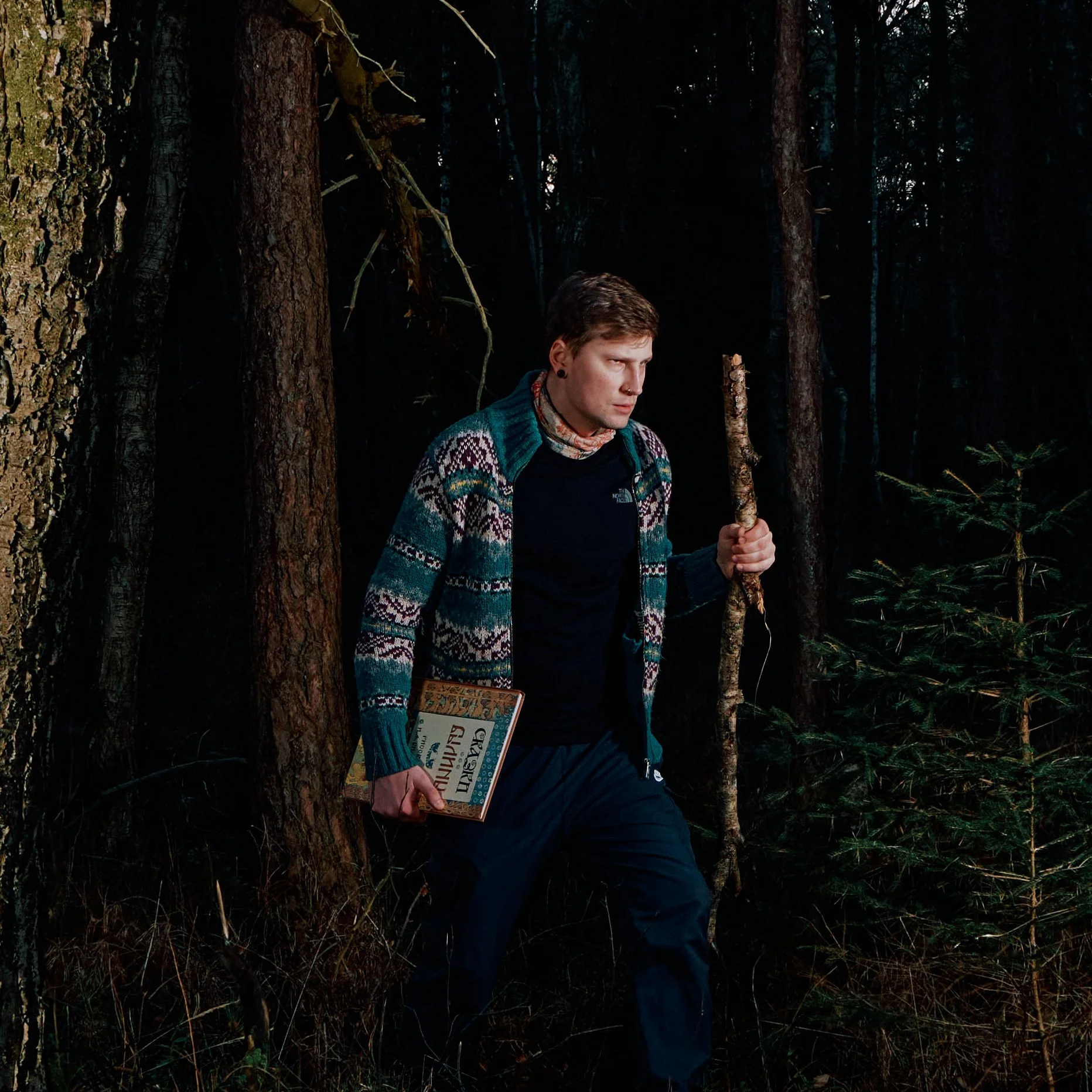
My name is Vlad Laptev. I live in the Southern Palatinate and work in the field of documentary photography. Born in Kazakhstan and having moved to Germany during my school years, I carry experiences from both worlds: the post-Soviet space and the German province. This double grounding shapes my gaze and the way I read places, people and situations. Before turning to photography, I spent several years working in a technical industrial profession, then made a conscious decision to leave it behind and studied Documentary Photography and Photojournalism in Hanover. Since then, photographic work has become my main professional and intellectual focus, which I continue to develop in both independent and editorial practice.
I am interested in situations in which everyday life loses some of its self-evidence: moments just before or after a change, scenes in which history, cultural knowledge and lived practice quietly manifest themselves in gestures and spaces. Spectacular events play hardly any role for me; what moves into the centre instead are subtle shifts, transitions, residual spaces and places where order, rupture and an often unexpected form of beauty overlap. The images are articulated as concrete situations in which gestural, spatial and cultural codes intersect. From their interplay emerges a narrative and emotional dimension that lends itself less to being named in words than to being traced in the act of reading the photograph. Some of these codes are rooted more in post-Soviet experience, others strongly in the German or Western European context. Taken together, they form a mode of visual coding that can be most fully deciphered by someone who stands between these worlds.
My photographic practice follows less a strict project logic than a way of seeing that has developed over the years. Many images arise from a moment in which a situation condenses for me and acquires an inner coherence, without my having a fully articulated idea in mind at the moment of exposure. Theory, experience and biography are present in the background and become visible to me primarily in the editing process and in working with series and sequences. What emerges from this over time I do not understand as a closed narrative, but as an ongoing engagement with the reality in which I live, with my own position within it, and with myself.